on the Abbott Kinney Pier Venice (Los Angeles), CA 90291 |
map - approximate |
Opened: The Venice Auditorium opened in 1905, a project of Abbott Kinney. Jeffrey Stanton, in his article about the Abbott Kinney Pier, relates that construction, begun in September 1904, was nearly complete on the pier and its two buildings when storms in February and March 1905 turned it all into a pile of driftwood.
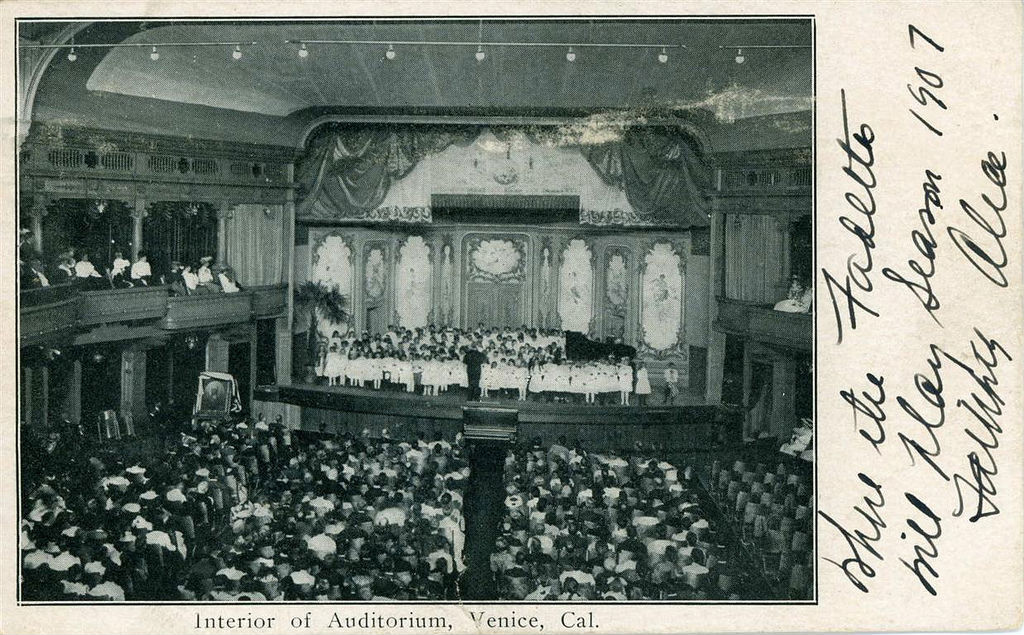
Undaunted, Kinney started construction again and even expanded his plans, ending up with a longer pier than originally envisioned. The second attempt at constructing the Auditorium took about five weeks and cost a reported $96,000. The opening was July 4th for a two-month cultural event called the Venice Assembly. The c.1905 postcard appears on the site Penny Postcards from California. Also on the pier was the Venice Theatre, farther in toward the beach.
Kinney's paper, The Los Angeles Saturday Post, according to articles located by Nicholas Beyelia, described the theatre as:
"a substantial and beautiful building, perfect in acoustic qualities... beautifully designed in the classic style of architecture... surrounded by a promenade twenty-five feet wide, is closed with drop sashes, and can be converted into an open-air pavilion or an enclosed auditorium at will. By this means two thousand additional people can be accommodated when necessary. The interior arrangement is on the order of a modern theater but so arranged that the seats can be removed to leave floor space 126 x 175 feet that may be used for dances, receptions, etc."
Another Post story Nicholas found noted that:
"all the latest devices necessary to perfect the most modern theater have been introduced in this building... special attention has been given to the stage appurtenances which include the most perfect switchboard of any theater in the west."
An early operator was Ward McFadden, even getting his name on some postcards. In the off season the auditorium was set up as a dining and music venue called as the Venetian Gardens or the Palm Gardens. In the 1913 city directory Speers & Middleton were listed as the managers. In the 1915-16 Santa Monica directory it was listed as being managed by George J. Cleveland, who soon moved down the pier to manage the Venice Dancing Pavilion.
Seating: 3,000
Early events at the Auditorium included lectures, dances, church services and occasional full stage presentations including an adaptation of Helen Hunt Jackson's novel "Ramona" and a production featuring Oscar Dane in "Dr. Jekyll and Mr. Hyde."
The big southern California theatrical event of 1906 was a May 18 and 19 "farewell tour" appearance of Sarah Bernhardt in "La Sorciere," "Camille" and "La Tosca" at the Venice Auditorium. She made a total of five appearances in Los Angeles between 1891 and 1918. See Nicholas Beyelia's wonderful article "
Divine Prominence: Sarah Bernhardt in Los Angeles, 1891" on the Los Angeles Public Library's blog for the story of her engagement that year at L.A.'s
Grand Opera House on Main St.
"It was around this time that a theatrical programmer in Los Angeles approached William Connor (Bernhardt’s American manager) with the intent of bringing Sarah Bernhardt to the City of Angels for the first time in fifteen years. In addition to a substantial amount of money, the man was offering the world’s greatest actress the only thing her artistic soul may have had a hankering for at this point—a fully equipped brick-and-mortar theater independent of the Syndicate... There was one hitch to the offer—it wasn’t exactly in Los Angeles; in fact, it was 16 miles west of L.A. in a themed resort community. The stage where she would perform was situated twenty feet above and one-quarter of a mile over the Pacific Ocean.
"For Bernhardt, who touring not only served as a means to earn a living but to feed a never-satiated hunger for new experiences, this was tantalizing. The woman who had performed on every major stage throughout Europe, South America, and North America had never performed in a venue that placed her directly over the ocean. Moreover, the Divine Sarah was intrigued by something that was virtually unheard of in Europe: a brand new city—and this one happened to be styled in the manner of one of Europe’s most breathtaking destinations. So, with the entirety of Los Angeles following this lady pied piper, Sarah Bernhardt was about to take Venice of America by storm."
For the tale of her 1906 Venice engagement see "
Circus Tents... Sarah Bernhardt in Los Angeles, 1906 - Part II." The Venice booking was arranged by impresario Lynden E. Behymer, also associated with the Syndicate-affiliated
Mason Opera House. Others that had made a pitch for the booking were Sparks Berry at the
Auditorium (which wasn't quite finished) and Oliver Morosco for his
Majestic Theatre (not even under construction yet). She was to play the
Majestic Theatre in San Francisco but it was
destroyed in the May 1906 earthquake. After playing relief benefits in
Chicago, she returned to the west coast for shows in Oakland and
Berkeley. The Venice booking had been under discussion before the earthquake. Nicholas has the story:
"... The Venice contract would offer Bernhardt $18,000 (nearly $650,000 in 2025 USD) for three plays over a two-day period: two evening performances and a matinee. It's not clear when the contracts were finalized, but the uncertainty kept the event in the news. On April 15, The Herald was still reporting that Bernhardt 'may come' to Los Angeles and was advocating for the Venice Auditorium rather than a tent in a weed-filled lot somewhere; the paper also attempted to shut down the ongoing complaints about Venice's 16-mile distance: 'will Sarah Bernhardt in a tent, accompanied by many discomforts and bad acoustics be more acceptable to the Los Angeles public than to her in a comfortable auditorium at Venice with all the lighting effects, music accessories, stage effects, etc?'
"Then, on the 18th, the San Francisco earthquake threw everything into disarray. There were contradictory reports regarding the cancellation of the Venice performances—On April 30, the Herald reported that the performances would happen, while as late as May 5th, the Times reported that the Venice performances had been canceled. The reason behind the contradictory reports are unclear, but Bernhardt's appearance occurred a full week before she was originally slated to appear (pre-earthquake), and that may have been behind the confusion."
An ad for the May 1906 Sarah Bernhardt engagement that Nicholas located in the L.A. Record.
Another newspaper ad that Nicholas located listed some of the "Special Attractions."
The cover of the Venice Auditorium program from the Theatre Program Collection of the Los Angeles Public Library. For inside pages from the program and an extensive discussion about the three productions see Nicholas Beyelia's article "
Circus Tents... Sarah Bernhardt in Los Angeles, 1906 - Part II." While she was at Venice Sarah parked her private railway car on a siding that went out onto the pier.
The front of the program for a July 12, 1908 performance of "The Merchant of Venice" that's in the Theatre Program Collection at the Los Angeles Public Library.
Behymer booked a number of Chautauqua-style lectures into the Auditorium. This program for the day's events on July 18, 1908 that ended with a performance of George Bernard Shaw's "Candida" is from the Theatre Program Collection at the Los Angeles Public Library. Thanks to Nicholas Beyelia for including this, as well as the "Merchant of Venice" program above, in "
Circus Tents.. Sarah Bernhardt in Los Angeles, 1906 - Part II," his article on the Los Angeles Public Library blog.
Films were occasionally shown in the Auditorium. "Birth of a Nation" drew thousands in 1916. It appears that by 1917 it became a full time film house. The directory that year lists Charles Jacobs as manager of the "Auditorium Theatre" and noted "motion pictures." In the 1919-1920 edition of the city directory E.C. Willis was managing and they again noted "motion pictures." In that edition they listed the address as "Windward Ave. Pier."
A November 12, 1920 ad in the Venice Evening Vanguard.
A December 17, 1920 Vanguard ad for D.W. Griffith's "Way Down East." Thanks to Ken McIntyre for locating these two ads for a post on the Photos of Los Angeles Facebook page.
Closing: The end came on December 20, 1920 with a massive pier fire. A new pier was constructed for the 1921 season with various attractions added over the years. It had a dance hall but no theatre. It came to an end in 1946 when the City of Los Angeles wouldn't renew its tidelands lease and wanted it dismantled.
Interior views:
A view Nicholas Beyelia located that had appeared in Abbott Kinney's paper Los Angeles Saturday Post.
A
1907 postcard view of the interior set up for refreshments and music.
It's from Jeffrey Stanton's extensive collection and appears on his fine
Venice History Site. He comments:
"Kinney found an alternative use for his pier auditorium during the
off-season and converted it into the Venetian Gardens. It served
refreshments to patrons seated at tables while Ellery's 52 member Royal
Italian Band entertained from the stage."
More exterior views:
1905 - The Ship Cafe well underway and framing getting started for the Auditorium. It's a June 5 photo from USC's Los Angeles Examiner Photographs Collection appearing on the
USC Digital Library website.
1905 - The Ship Cafe and the still uncompleted Auditorium. It's a photo in the
Los Angeles Public Library collection. The Ship, also at one time known as the Hotel Ship Cabrillo, was built on pilings.
1905 - Another view as construction was being completed. Here we can see the pilings under the Ship Cafe. It's a photo from the California Historical Society appearing on the
USC Digital Library website.
1905 - A view from the rear as construction progresses. Thanks to Noirish Los Angeles contributor Ethereal Reality for spotting this when it was on eBay. It's on Noirish post #61036.
c.1905 - The railway siding leading out to the Auditorium. When Sara Bernhardt played the theatre in May 1906 her private railway car took this route out to the pier. It's a photo from the Los Angeles Public Library collection that Nicholas Beyelia included in his article "
Circus Tents... Sarah Bernhardt in Los Angeles, 1906 - Part II."
c.1905 - An entrance view from the collection of the late Chrys Atwood.
1906 - A lovely view with an August 20, 1906 postmark from the
Card Cow collection. Of course the site has many more
Venice postcards to browse. Another version of the card appears on Ethereal Reality's
Noirish Los Angeles post #10094.
1906 - The photo the card above was made from. It's in the California Historical Society collection and appears on the
USC Digital Library website. The caption on the site calls our attention to the two American flags in the right foreground flying from what appear to be photo booths. Signage reads "Franklin Photo Co. Makers of Novelty Photos."
c.1906 - A photo by M. deHaaf in the USC Los Angeles Examiner Photographs Collection appearing on the
USC Digital Library website.
c.1906 - A card based on a photo taken from up on the Ship Cafe. It's in the Venice collection on the site
Card Cow.
c.1906 - A photo from the California Historical Society appearing on the
USC Digital Library website. The structure on the shore with the peaked roof is the Venice Bandstand.
c.1906 - The artist has taken a bit of liberty with this card and brought in an exceptionally high tide. It's a card appearing in the Venice section on the site
Penny Postcards from California. Presumably the card was done using the USC photo above.
c.1906 - The same "high tide" image but made into a night view. It's on the site
Card Cow where they note that their copy has a 1909 postmark.
1907 - The Auditorium, the Ship Cafe, and the dance hall as seen from Sunset Pier. It's a Detroit Publishing Co. image in the
Library of Congress collection.
c.1909 - The stage end of the building. It's a photo in the
Los Angeles Public Library collection. The Library also has a
1910 shot of a woman on the beach with the Auditorium in the background.
c.1909 - A view from the beach from the California Historical Society collection. The photo appears on the
USC Digital Library website. Note the back of the Dance Hall on the left. It went up in the summer of 1906, completed (more or less) in 17 days.
c.1909 - A card with a March 25, 1911 postmark from the site
Card Cow. On the right that's the more decorative side of the Dance Hall. Also see a nice 1909 card of the front of the Dance Hall on
Card Cow. A different card of the Dance Hall is on the site
Penny Postcards from California.
c.1915
- Thanks to Mark Flores for sharing this shot looking toward the beach.
The auditorium is on the left. Note that "Vaudeville" sign strung
across the pier. Mark comments:
"The man posing was Mason Abner Grover.
They were visiting from North Dakota. They must have
liked the weather. Years later they moved to Inglewood."
On the far right is a new glass blower's shop with a Ferris Wheel and the
masts of the Ship Cafe beyond. The Ferris Wheel was new for the 1911
season and had come from the Seattle's Yukon-Pacific Exposition. The
"Rink" signage across the pier refers to an outdoor track this side of the Ferris Wheel in an
area that had opened as a circular Automobile Races attraction in 1911. Jeffrey
Stanton notes that the center was left open when it was converted to a
rink in 1914 so skaters could look down at the ocean. By the time the 1918 Sanborn map (below) was issued, the Rink was reduced to being only a semi-circular configuration.
1918 - This lovely map of the pier appears as image 62 of the Sanborn Fire Insurance Map for Santa Monica
that's in the Library of Congress collection. Also see the pier map on image 34 of the 1909 Sanborn Map. On the LOC site you can zoom in to look at details.

1920 - Thanks to Jeffrey Stanton for this Abbot Kinney Pier map
appearing on the site Westland.net. The Auditorium, way out on the pier, is #11. The version on the site has links that once went to many
photos from his collection. They still go to some text but all the
photos have vanished.
Map Key
1. Venice Plunge
2. Sea Swings
3. California Theater
4. Bandstand
5. Billiard Hall & Bowling Alleys
6. Cafeteria
7. Dance Hall
8. Virgina Reel
9. Whip
10. Great American Racing Derby
11. Auditorium
12. Aquarium
13. Flying Seaplanes
14. Tea Garden & Zoo
15. Over the Falls
16. Hellarity Hall
17. Captive Aeroplanes
18. Clay Pidgeon Gallery
19. Roller Skating Rink
20. Ferris Wheel
21. Ship Cafe
22. Ocean Inn
23. Merry-go-round (Dentzel)
24. Noah's Ark
25. Mill Chutes
26. Big Dipper roller coaster
Mr. Stanton is the author of "
Venice California - Coney Island of the Pacific,"
available from the author by check or money order for $59.57, including
tax. He's at 12525 Allin St. Los Angeles 90066. His email:
jeffreystanton@yahoo.com.
1920 - A view of unknown provenance that appears on the
Wikipedia page about the Abbot Kinney Pier.
1920
- A detail from the image above. The green circle in the upper left is
the
California/Venice Theatre, opened in July 1920. Over to the right
near the coaster is the site of the
Venice Theatre
that was earlier on the pier. By the time of this shot it had been
turned into a shooting gallery. Way out on the pier it's the Venice Auditorium.
1920 - The pier burned in a few hours on December 20. It's a photo from the Ernest Marquez collection appearing on the
Huntington Library website.
1920 - This photo from Jeffrey Stanton's collection appears with his article about the Abbott Kinney Pier.
He notes that the fire started in the Dance Hall and quickly spread
along the pier in both directions. The buildings along Ocean Front Walk
were spared only due to a change in the direction of the wind. The pier
and its buildings were a total loss.
1920 - Looking
out to where the Auditorium had been, over to the left. The tower is from the pier's
airplane ride. The December 21 photo from the Ernest Marquez
collection appears on the
Huntington Library site.
See the page about the
Venice Theatre, once on the pier but closer to Ocean Front Walk, for several additional post-fire shots from the Santa Monica History Museum. They're looking toward St. Mark's Hotel, spared in the fire.
A new pier was built for the 1921 season and opened May 28. It survived until 1946. See Stanton's Venice Amusement Pier
article for that history and a fine discussion of its attractions.
Stanton notes that Venice was annexed to the City of Los Angeles in
November 1925 and due to L.A.'s blue laws and various licensing
restrictions, business started shifting north to Santa Monica's Ocean
Park. When the pier closed it was because the City of Los Angeles
refused to renew the Kinney Company's tidelands lease.

2019 - Looking west from Ocean Front Walk in search of the vanished pier. Photo: Bill Counter
More Information: Visit Jeffrey Stanton's terrific Venice History Site hosted on Westland.net. Don't miss his Venice Timeline and the article on the Abbott Kinney Pier. Also see a separate Venice History section on the site that was compiled by others.
Other Venice history resources are listed at the bottom of the Theatres Along the Coast survey page here on this site.
| back to top | Theatres Along the Coast | Along the Coast - list by address | Downtown theatres | Westside theatres | Hollywood | Westwood and Brentwood | [more] Los Angeles movie palaces | Los Angeles theatres - the main alphabetical list | Los Angeles theatres - list by address | theatre history resources | film and theatre tech resources | contact info | welcome and site navigation guide |




No comments:
Post a Comment