Start your Los Angeles area historic theatre explorations by heading to one of these major sections: Downtown | North of Downtown + East L.A. | San Fernando Valley | Glendale | Pasadena | San Gabriel Valley, Pomona and Whittier | South, South Central and Southeast | Hollywood | Westside | Westwood and Brentwood | Along the Coast | Long Beach | [more] L.A. Movie Palaces | Site Navigation |

To see what's recently been added to the mix visit the Tours and Events page, the Theatres in Movies site and the Los Angeles Theatres Facebook page. Questions? Contact us.

Showing posts with label pussycat theatres. Show all posts

Wardman Theatre / Whittier Village Cinemas

7038 Greenleaf Ave. Whittier, CA 90601 | map |


Opened: March 15, 1932 as the Wardman Theatre. The building is at the northeast corner of Greenleaf Ave. and Wardman St. with the theatre entrance up in the middle of the block. 

The 1937 photo of the theatre giving away money on Tuesday nights is from the Whittier Historical Society collection. Thanks to Deysi Flores at the WHS for finding the photo. www.whittiermuseum.org | WHS on Facebook. There's a wider postcard version lower on the page.

Phone: 562-907-3300  Website: starlightcinemas.com

Architect: David S. Bushnell designed the house for Aubrey Wardman with the expectation that it would be leased to Fox West Coast and called the Fox Whittier. Bushnell had earlier designed the Whittier Theatre.
 

A sketch of the new theatre from Bushnell's office that appeared in the Fox West Coast "Now" magazine on April 16, 1930. Thanks to Mike Hume for locating it on Internet Archive. Visit Mike's Historic Theatre Photography site for thousands of terrific photos of the many theatres he's explored. The photo's caption: 

"At the top is architect's conception of the new Fox Theatre to be erected in Whittier at a cost of $150,000. The seating capacity will be in excess of a thousand. The building will contain eight stores. It is possible before construction is started that revisions may be made to include eight stories of apartments."

Seating:  The original seating capacity as a single screen house isn't known but, as the item above notes: "in excess of a thousand." It now, as an 8-plex, has a total of 992. In addition to subdividing the original house, there was a big addition. Capacities are #1 - 262, #2 - 190, #3 - 109, #4 - 40, #5 - 110, #6 - 56, #7 - 137, #8 - 88.
 

What was still envisioned as the Fox Whittier appeared in the lower left of this illustration from the May 4, 1930 issue of the L.A. Times. The caption: 

"Designs For Various Cities Shown - To the upper left is depicted the Warner Brothers Theater at Wilshire Boulevard and Reeves Drive in Beverly Hills, to be started this month. To its right is shown the Fox Pantages Theater at Hollywood Boulevard and Argyle, the opening date for which has been set for the 29th inst. 
 
"To the lower left is the Fox Theater soon to be built on Greenleaf avenue, Whittier, while Warners' San Pedro project is pictured at the lower right. In the center is the Fox Wilshire Theater now being erected at Wilshire Boulevard and Hamilton, Beverly Hills. Completion is scheduled for September."

Also see "Theatre Work Planned," the accompanying article. As far as other Fox projects in the pipeline they mentioned the Los Angeles Theatre and the Fox Pomona. Fox theatres mentioned for Beverly Hills and Huntington Park never happened. Thanks to Mike Hume for locating the article and illustration. As far as the Whittier project they noted: 

"Fox West Coast Whittier theater to cost $150,000. Soon to be started on South Greenleaf avenue. Plans prepared by David S. Bushnell, engineer."

At some point during construction, with Fox West Coast in receivership, they defaulted on their lease. Owner Aubrey Wardman went ahead to finish the building. Ron Pierce notes that when it opened it was with the architect acting as the theatre manager.


An ad for the upcoming opening that appeared in the March 12, 1932 issue of the Whittier News. Thanks to Anne Collier for locating it.


An item about the new theatre that appeared in the Whittier News on March 16. Thanks to Anne Collier for locating it.
 
Greenleaf got renumbered at some distant time. The address is listed variously as 132 1/2, 132 and 160 S. Greenleaf Ave. in early directories. In the 1950s the Wardman was part of the Bruen chain. Hugh W. Bruen also ran the Whittier Theatre, the Roxy and the Sundown Drive-In. The Roxy closed in 1968. Pacific Theatres ended up with the rest including a mall house that had opened in 1968, the Whittwood. 
 
In early 1974 Malcolm Hardy's firm Century Theatres, Inc., leased the three indoor houses from Pacific. He comments: 
 
"We took over the Whittier, Wardman and Whittwood all on the same day. We opened the Whittwood with the re-release of 'Gone with the Wind' that ran three weeks and was followed by 'The Towering Inferno' with 'GWTW' moving over to the Wardman. We reseated the Wardman and put in new drapes. We also redecorated and put in new drapes at the Whittwood. Oh, the rent on the Whittier theatres (all 3) was $7.000 a month." 

He had started the company by taking over the Rivoli in Long Beach in 1973 and soon also had the Reseda Theatre, the Cameo in El Sereno and the Cove in Hermosa. Jim Lytel was his district manager. Century also operated the Rialto and Highland Twins in San Bernardino, the Pismo Theatre in Pismo Beach, the San Luis Obispo Drive-In, the Town in Gilroy and the Mt. Burney Theatre in Burney. In 2024 Malcolm recounted his career: 

"Movie theatres have been my life since I was 15 years old. I am British and now live back in UK, I am retired but I lease a theatre here, and it is live shows, like 60s bands, and those type of shows. When I left school my first job was trainee projectionist at an Odeon (rewind boy). There were five in the booth, Chief, second, a third and two boys. After 6 years I went to London, moved to management, first as a trainee then as an assistant, then worked for the Rank Organisation as a manager in the West End. I was manager of the Odeon Haymarket and I would help out at the Leicester Square Theatre. When the manager, who had been there 32 years, retired I moved in as manager. 

"It was a theatre that held the Royal premieres. I met the late Queen, the Queen Mother and a number of movie stars, just for a few seconds in the lineup. In 7 years they played only 3 movies: 'Goldfinger,' 'Mary Poppins', and 'The Inn of the Sixth Happiness.' In 1970 Rank closed the theatre to twin it (made a right mess). I booked 10 days in New York, and at the airport met a friend from my school, so we teamed up together. After a week we decided to go to LA. Thirty-four years later I was still there. Anyway, got an apartment on Willshire, then moved to a small house next to Paramount Studios. My first job was at the Vagabond, as projectionist. I left the Vagabond with intentions of returning to UK, but decided against it, but now had no job. 

"I found a job at Will Wright's ice cream shop in Beverly Hills and in five months I became manager. There I met Lucy Ball, also Alfred Hitchcock (both came for ice cream specially made). Every Thursday night a guy came in, started asking where I was from and what I did. About 4 weeks later, I was off on that Thursday, and he left a message for me to call him the next day. His name was Mike Forman. I telephoned and they answered 'Pacific Theatres.' 'Oh,' I said. 'I got this number to call Mr. Forman, does he work there?' !! 'Yes,' she said. Well, he invited me to lunch at Musso and Franks, and offered me the Rivoli Theatre in Long Beach, and later the Whittier theatres. Set me up with office desks and a film booker, which was first at the Whittwood, later moving to a building on Wilshire, then to the 9000 Sunset building.

"Thus I was 28 years old when I started Century. It was great fun and I ran a top-notch operation. A number of theatres had first run product, we spent money of Dolby Sound, redecoration, new seats, new projection and platters. I operated the company for 18 years. Then came the building of the multiplex theatres! I just never had the money or the investors to get into the multiplex business. I then went to work for United Artists as manager of the Metro in San Francisco, and later as district manager for Tom Moyer in Oregon, which was taken over by Act III Theatres."

Malcolm Hardy's Century firm shouldn't be confused with the mid-1970s Century Cinema Circuit headed by Fred and Robert Stein that was also operating in the LA area.
 

Projectionist Russ Tice in the Wardman booth in 1974 with a Motiograph AAA, Motio SH-7500 soundhead and Ashcraft lamp. Thanks, Russ! The photo was a post on the Reel Projectionists Facebook page.

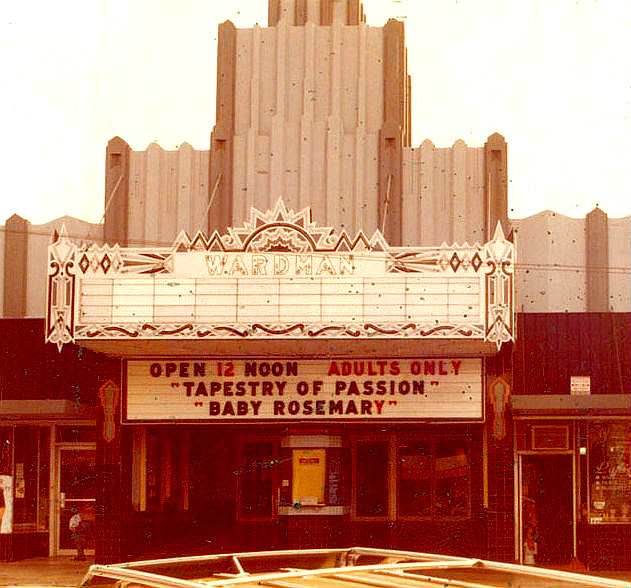
Vincent Miranda's Pussycat Theatres chain bought the theatre from Pacific in 1977 and put "It's a Pussycat Theatre" on the marquee. The city fathers tried, unsuccessfully, to convince him to turn it into a four-plex and run Hollywood product. The city ran up a huge legal bill trying to close the theatre. 
 

Help wanted ads in 1985. Thanks to Ken McIntyre for locating these for a thread about the theatre on the Ken's Movie Page Facebook group. 

The theatre (then still a single screen operation) took a hit with the 1987 Whittier Narrows earthquake and closed as a result of damage. This article appeared in the October 8, 1987 issue of the L.A. Times:


Thanks to Ken McIntyre for locating the Times coverage.

Candi Nash comments: "Rumor has it that the owners were unable to obtain a permit from the city to repair damage." The theatre stayed closed until it was sold.

Status: It reopened in 1990. Now, with an addition, it's an 8 screen multplex operated by Starlight Cinemas as the Starlight Whittier Village. The original auditorium has been divided in two. In a later renovation stadium seating was installed.

The former snackbar area and the rear of the main floor (now a space under the stadium seating) has become a game room. Evidently some of the original decor still exists in unused spaces upstairs, including several restrooms and a room with Egyptian themed decor. The staircase to upstairs was near the now-vanished snackbar.

Interior views:


Checking out the snackbar. It's a 2011 photo from the owner, Starlight Cinemas, appearing on Yelp. At last look, the site had 161 photos of the complex.


An inner lobby view. Photo: Starlight Cinemas - Yelp - 2011


A view of one of the auditoria. Photo: Starlight Cinemas - Yelp - 2011


A look to the rear of one of the houses. Photo: Starlight Cinemas - Yelp - 2011


Across one of the other auditoria. Photo: Starlight Cinemas - Yelp - 2011


More exterior views:  
 

1937 - A postcard view up Greenleaf. The image at the top of the page is a detail from this photo. Thanks to Jeanne Bolstein for including this one in a post for the Southern California Nostalgia private Facebook group. It also appears with Nicholas Edmeier's 2023 article "History of Whittier Movie Theaters" on the Whittier Museum blog.


c.1942 - A shot from a short Warner Bros. video clip appearing on the Getty Images site. Thanks to Ken McIntyre for locating it for a thread about the theatre on the Ken's Movie Page Facebook group. 


1970s - The Wardman when it was operated by Century Theatres. Note "Century Theatre" on the end of the marquee. Thanks to Steven Otto for sharing his photo.


1976 - A panorama showing the block before the theatre's redevelopment and expansion.That's Wardman St. on the right. It's from the Whittier City Clerk - Treasurer Department via the Whittier Public Library, indexed as item #STR-058b. Click on it for a larger view.


1976 - A detail from the City's panorama.


1983 - "It's a Pussycat Theatre." Thanks to the now-vanished American Classic Images website for this photo.


c.1988 - The theatre after its Pussycat days. It closed following damage from the 1987 Whittier Narrows earthquake. Thanks to Candi Nash for sharing the photo. It was in a post on the SoCal Historic Architecture Facebook page that also included six additional views.


1989 -  A photo from the Herald Examiner collection at the Los Angeles Public Library


1990 - During the renovation. Thanks to Steven Otto for sharing his photo as a comment to a post about the theatre on the All Movie Theatres Facebook page.


2009 - A view taken by Don Solosan that was part of a survey by the now-dormant Historic Theatre Committee of the L.A. Conservancy to determine the condition of surviving historic theatre buildings in L.A. Thanks to Hillsman Wright of the Los Angeles Historic Theatre Foundation for making Don's photos available.


2009 - Thanks to Don Solosan for this facade view. 


2009 - A peek into the ticket lobby. Photo: Don Solosan


2009 - A terrazzo detail. Thanks to Michelle Gerdes for sharing her photo. It's in her Theatres- California album on Flickr. See the index page for the photo sets from various theatres she's visited. 


2009 - Deeper into the ticket lobby. Photo: Don Solosan
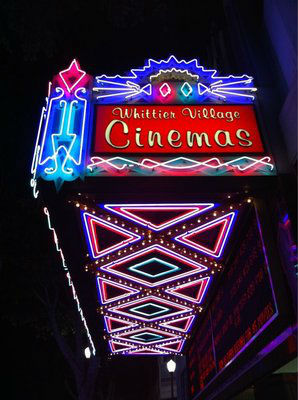


2010 - A soffit view from Kat J. on Yelp


2011 - A look along the storefronts. Photo: Google Maps


2011 - At Wardman St. looking north along Greenleaf across the new addition toward the original building. Photo: Google Maps


2012 - An alley view behind the building looking toward Wardman St. The corner nearest us is the original auditorium. Photo: Google Maps


2013 - A fine marquee shot from Trixa B. on Yelp. The photo also appears (uncredited) as #32 on a list of 50 movie palaces in "American Movie Palaces: 50 Living Relics of U.S. Film History," a May 2016 Paste Magazine article by Whitney Brandt. Evidently nobody told him it had been multiplexed with no historic elements left inside.


2014 - A fine view of the signage. Thanks to Granola for posting the uncredited photo on Cinema Treasures


2019 - Looking south on Greenleaf. Photo: Google Maps 


2024 - The entrance from across the street. Photo: Bill Counter  


2024 - The ticket lobby. Photo: Bill Counter


2024 - A closer look at the original boxoffice. Photo: Bill Counter


2024 - Looking south along Greenleaf Ave. Photo: Bill Counter


2024 - The end panel of the theatre's marquee, dating from 1932. Photo: Bill Counter 
 
More information: See the Cinema Treasures page on the Whittier Village Cinemas for some good research. The Cinema Tour page has ten 2004 exterior photos.
 
See Nicholas Edmeier's 2023 article "History of Whittier Movie Theaters" on the Whittier Museum blog.  

Lyric Theatre

7208 Pacific Blvd. Huntington Park, CA 90255 | map |


Opened: June 30, 1922 at the corner of Florence and Pacific in the Walnut Park business district. A.F. Sanders was the initial owner. In the 1928 city directory it's listed as at 7210 Pacific. The Lyric is just a few blocks south of the other theatres in Huntington Park including the Warner, the Park and the California.

The 20s photo is from the Los Angeles Public Library collection. On the end of the marquee: "Vaudeville." In the 20s the Lyric ran vaudeville shows along with their movies but later segued into just being a film house.

Architect: A.H. McCulloh of Walnut Park. The project was announced in the May 27, 1921 issue of Southwest Builder & Contractor.

Thanks to Pacific Coast Architectural Database for the data. They also note that the theatre rated three stories in the L.A. Times: "Lyric Theater, Huntington Park" on page 14 of section V on May 21, 1921, "New Business Building at Walnut Park" on page 2 of section V on July 17, 1921 and "To Open Suburban Theater" on page 14 on June 25, 1922.

Seating: 968 in later years, according to Cinema Treasures. The original announced capacity was to be 1,100. 
 

In 1925 it was taken over by Hansen Theatres, Inc. This item appeared in the September 16 issue of Variety.  

The principals were Mark Hansen and film star Alice Calhoun. Joseph G. Curl was also part of the firm. Mark and Alice were involved in operating other theatres including three houses in Oxnard, the La Mirada Theatre on Vine St. (later called the Filmarte), the Larchmont Theatre, the Marquise Theatre on Melrose, the Strand Theatre in San Pedro and the Marcal Theatre on Hollywood Blvd.   

Fox West Coast eventually grabbed it and for years it was under their management. It's in the 1946 directory as the Fox Lyric. By the late 50s it was already showing softcore exploitation films. It got more daring around 1961. 
 

 A fine 1963 ad for "The Luxurious Lyric." Thanks to Scott Pitzer for locating it.

Closed: The theatre closed sometime in the 1980s. When the Lyric closed it was part of the Pussycat chain but always kept the Lyric name.

Status: The building is still standing. There's retail in the former lobby. The auditorium has been double decked for numerous small offices and retail. There may be wondrous things above some ceilings but there's nothing of interest to see in the public areas.


1943 - Playing the week of the photo were "Let's Face It" with Bob Hope and Betty Hutton along with "Above Suspicion" with Joan Crawford and Fred MacMurray. It's a photo in the Los Angeles Public Library collection.


late 1950s - A lovely view north on Pacific Blvd. with the Lyric Theatre on the right. Thanks to Sean Ault for sharing this photo from his collection.


late 1950s - A detail from Sean's photo. 


1961 - A look at the terrific marquee that was once on the Lyric. "Magic Spectacles" was a nudie-cutie adventure but you needed to be brave and bold. Thanks to Bill Gabel for finding the photo for a post on Cinema Treasures. Ken McIntyre later did a post of it on the Photos of Los Angeles Facebook page.


c.1980 - A Gary Graver photo.  Graver was a filmmaker and cinematographer who took many photos of dying single-screen theatres in Los Angeles. A compilation can be seen on YouTube: "Second Run - part 1" and "Second Run - part 2." Thanks to Sean Graver for use of the photo.


1983 -  A bit of a makeover. Thanks to the now-vanished American Classic Images website for this photo.


1983 - Another American Classic Images photo, this time from a bit to the south. Thanks!


2010 - The Lyric Theatre building after a bit of remodeling. The theatre entrance used to be on the right side where the green awning is. Thanks to Lanna Pian for sharing her photo.


2012 - The side of the building. The auditorium has been gutted and double decked for a two story warren of offices. Photo: Bill Counter

More Information: See the Cinema Treasures page on the Lyric Theatre for a bit of discussion. The Pacific Coast Architectural Database also has a page on the Lyric.

The Lyric is discussed in Jay Allen Sanford's 2010 San Diego Reader article about the Pussycat Theatres chain: "Pussycat Theatres: A Comprehensive History of a California Dynasty." The version now online with the SDR site is missing all its photos. A better version is on Blogspot: "Pussycat Theaters: The Inside Story - chapter 1" - chapter 1 and "Pussycat Theaters: The Inside Story - chapters 2-15."

| back to top | South, South Central and Southeast theatres | Downtown theatres | Westside theatres | Hollywood | Westwood and Brentwood | Along the Coast | [more] Los Angeles movie palaces | Los Angeles theatres - the main alphabetical list | Los Angeles theatres - list by address | theatre history resources | film and theatre tech resources | contact info | welcome and site navigation guide |