5905 Wilshire Blvd. Los Angeles, CA 90036 |
map |
Opened: The Leo S. Bing Theatre at the Los Angeles County Museum of Art opened March 26, 1965 with the premiere of Éclat, an original composition by Pierre Boulez commissioned for the occasion. It was a nicely equipped theatre that showed lots of revivals, foreign
films and more.
It was in the middle of the campus on the north
side of Wilshire just east of Fairfax Ave. In this 2010 LACMA entrance view it's the Broad Contemporary Art Museum on the left. The theatre was off to the right beyond the Ahmanson Building that we see behind Chris Burden's streetlight sculpture. Photo: Bill Counter
Architect: William L. Pereira.
The campus in 2015. It's another graphic from the Times. The Art of the Americas building was a 1986 addition designed by Hardy Holzman Pfeiffer that the Times, in a 2026 story, called "a Babylonian-scaled, belligerent Postmodern addition." From 1986 until 2007 it was called the Robert O. Anderson Building.
See Mary Mallory's 2020 Daily Mirror article "William Pereira, Entertainment Architect." Curbed L.A. had a 2020 story about the original buildings by Hadley Meares titled "LACMA is beloved. Its design never was." Time magazine called the complex the "Temple of the Tar Pits."
Seating: 600
The initial layout was a fairly small 1.33 format screen positioned at the back of the stage. The stage wings were masked with legs that ran upstage from the proscenium to the sides of the screen, continuing the angle of the auditorium side walls. Widescreen films were problematic with the only recourse being a reduction in height of an already small screen.
In 1992 they went big:
70mm capability was added in 1992 with installation a new screen, new sound system and Century JJ2 projectors. They celebrated with a festival of 16 films to show off the new capabilities. Thanks to Michael Coate for sharing
this June 18 ad from the L.A. Times. He notes that the July 10
"to be announced" screening turned out to be "Gandhi."
Later events in 70 included "One From the Heart" and another screening of "Apocalypse Now." Michael comments: "I bet 'One from the Heart' was during their Vittorio Storaro festival in, I think, 1999. I met Storaro there during that series (terrifying!) and saw a mint 70 of 'Apocalypse Now.'" Quentin Tarantino's "Hateful Eight" got an Ultra Panavision screening in November 2015.
Looking
into the booth and its Century 35/70s with Strong Super 80 lamps.
Thanks to Tyler Purcell for his photo. And also thanks to Corky Baines
for sharing it in a
Facebook post.
Checking
alignment and focus after setting up for a November 2015 Ultra
Panavision screening of Quentin Tarantino's "Hateful Eight." It's a shot from a 15 second video
clip taken by Tyler Purcell as documentation of the event. He shared
it as a comment to a post about the theatre on the
Los Angeles Theatres Facebook page.
Another shot from Tyler's clip. Thanks!
Status: The building was demolished in April 2020. The L.A. Times covered the event in Deborah Vankin's April 7 story "Demolition of LACMA begins. Here are the photos..."
It was a casualty of LACMA's controversial construction program that
replaced the 60s vintage buildings on the campus with a strange creation
designed by Peter Zumthor sprawling across Wilshire. There's a new theatre seating 300 intended to be a replacement, located on the ground floor of the south end of the building. See our page about the new Steve Tisch Theatre.
The theatre's entrance. Photo: Bill Counter - 2018
The outer lobby. Photo: Bill Counter - 2018
The inner lobby. Photo: Bill Counter - 2018
A closer shot of the front of the auditorium from the LACMA
Film Programs web page.
The view from the rear of the auditorium. The photo is from
Jason Brown on Flickr. Also see his 101 photo
LACMA Research set from 2008.
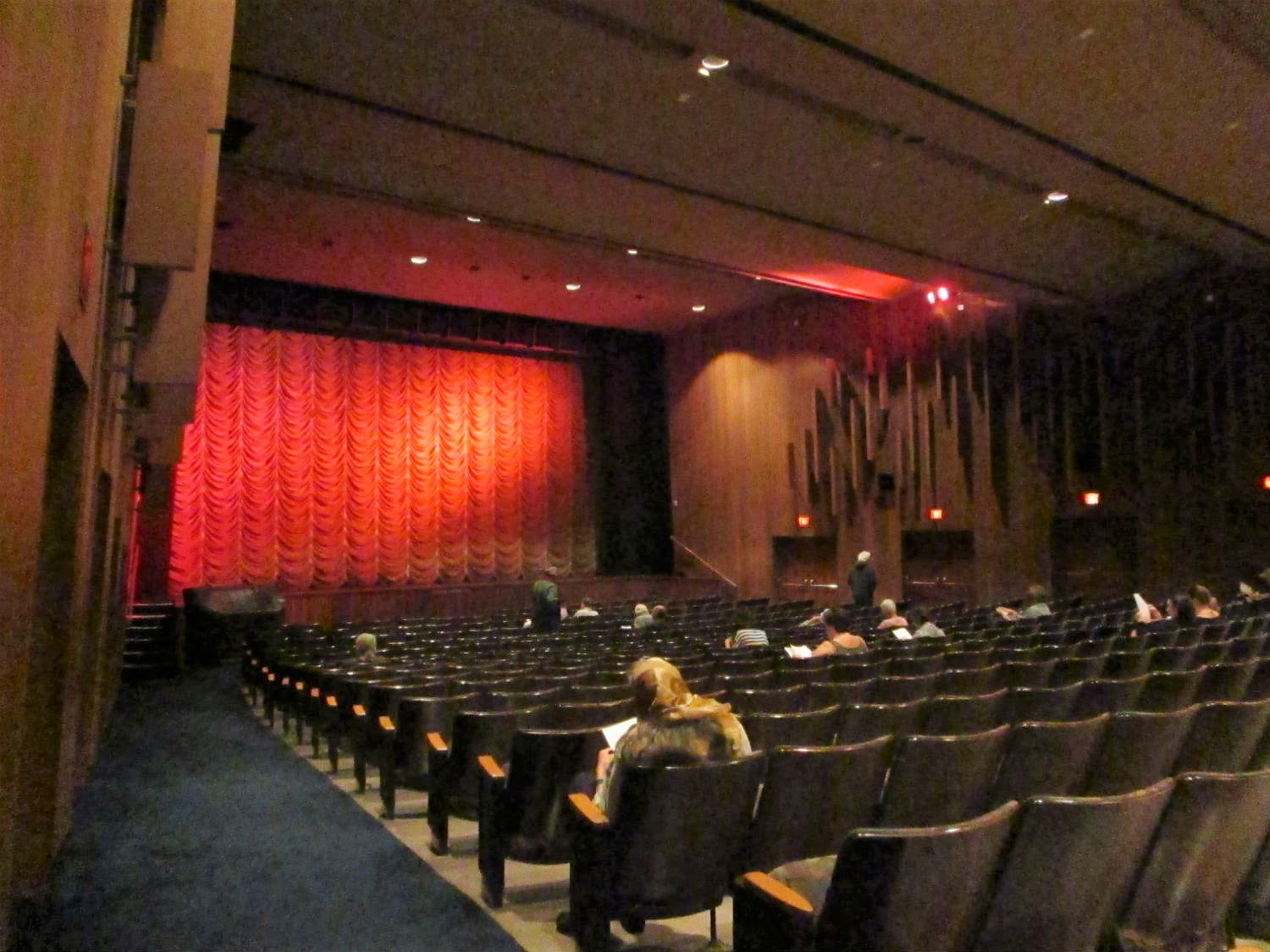
A shot from house left. Photo:
Jason Brown on Flickr - 2008
A look to the rear of the auditorium. Photo: Bill Counter - 2018
A panoramic view from house left. Click on it for a larger view. Thanks to Tyler Purcell for sharing his 2015 photo as a comment to a post on the
Los Angeles Theatres Facebook page.
There
was also a small digital-only screening room on the first floor of the
building. Thanks to Corky Baines for gabbing this shot off an old LACMA
web page.
More exterior views:
1965 - A photo from the March 28 issue of the L.A. Times. It appears on a page about LACMA from the
Los Angeles Conservancy. The Bing Theatre was in the building on the right. In the center it's the Lytton Building and that's the Ahmanson Buiolding on the left.
1976 - A photo by Robert Cameron appearing in his 1977 book "Above Los Angeles." LACMA is in the middle. The Park La Brea housing development is in the upper left. The May Company, now the
Academy Museum, is in the lower center at Wilshire and Fairfax.
1992 - A LACMA photo of the campus showing the newer Art of the Americas building in the center, the Japanese Pavilion in the upper right and the Bing Center this side of it.
2019 - The doomed Bing Theatre building as seen from Wilshire in April. Photo: Google Maps
2020 - Another demolition view by Allen J. Schaben for the L.A. Times. For more demo views see seven photos from
Paul Wright on the Photos of Los Angeles private Facebook group.
The Bing in the Movies:
The Bing Center, where the theatre was located, is seen on both sides of that huge column of the Art of the Americas Building that's out at the sidewalk line. It's a shot from Steve De Jarnatt's "Miracle Mile" (Hemdale Releasing, 1989). It looks like we'll have a
sweet little love story with Mare Winningham and Anthony Edwards as the
leads. Then it
all turns into a nuclear apocalypse.
Back at LACMA later in the movie with the Bing off to the left. Thanks to Steve De Jarnatt for sharing this screenshot. He notes that he did several early screenings of his film at the Bing. See the
Historic L.A. Theatres in Movies post for more shots at LACMA plus views of other neighborhood landmarks including the La Brea Tar Pits, Park La Brea, Johnie's Restaurant and Ohrbach's Department Store. Check out Steve's website for Miracle Mile items and posts on other topics:
www.stevedejarnatt.net
The Bing Theatre burns in "Volcano" (20th Century Fox, 1997). Tommy Lee Jones, working for L.A.'s Office of Emergency Management, tries to save the west side from lava that's flowing west on Wilshire, burning everything it touches. The film also features Anne Heche, Gaby Hoffman, Don Cheadle, Jacqueline Kim, Keith David and John Corbett. Mick Jackson directed. The cinematography was by
Theo Van de Sande.
The Bing in ashes in another shot from "Volcano." It had been in the area behind that white truck. See the
Historic L.A. Theatres in Movies post for more views of LACMA getting destroyed as well as earlier shots from the film of the Westlake Theatre and the Alvarado/Park Theatre.
| back to top | Westside theatres | Hollywood | Westwood and Brentwood | Along the Coast | Westside theatres: alphabetical list | Westside theatres: by street address | Downtown theatres | [more] Los Angeles movie palaces | Los Angeles theatres - the main alphabetical list | theatre history resources | film and theatre tech resources | contact info | welcome and site navigation guide |




what a disgrace that it was demolished for another cheap modern building.: (
ReplyDeleteYes, this is quite a loss. Very sad...
ReplyDelete