366 N. La Cienega Blvd. Los Angeles, CA 90048 | map |
Also see: the main Coronet Theatre page.
1947:
Paul Ballard's Hollywood Film Society: Although renowned as a legit venue, the Coronet's opening was actually with a film series curated by Paul Ballard beginning May 5, 1947. Previously the Hollywood Film Society used a residence in Hollywood.
Early film events in the complex had to work around the main
space's use as a legit venue. There's no indication that the Coronet ever had 35mm capability.
A Hollywood Film Society flyer for their initial series at the Coronet, running from May 5 until August 8, 1947.
The inside of the flyer. You can download it for a closer look.
A bit of a mission statement.
The back of the initial flyer. Note the scheduling, working around the theatre's primary use as a legit venue by John Houseman's Pelican Productions. They could use it Mondays without any constraints. But on Tuesdays and Wednesdays only shows at 5:20, to allow time to clear it out for a performance in the evenings at 8. On Thursdays and Fridays they did one show at 5:40. Saturdays they could run their kiddie matinees, a series that began July 26, 1947.
Thanks to Ranjit Sandhu for his research, including locating this flyer. See the PDF of his "
Paul Ballard at the Coronet" scrapbook. His coverage of film at the Coronet is intertwined with his extensively researched article on Buster Keaton's "
The General." See his
Coronet Theatre chapter.
A list of Paul's "Group A - Feature Films" and "Group B - Documentary" titles, with dates extending into mid-August 1947 -- beyond those listings on the initial flyer.
The "Group C - History of the Film" titles through July 23, 1947.
Paul Ballard's Children's Series started July 26, 1947.
The Children's series titles from July 26 until October 4, 1947.
A note about special Sunday screenings.
Program notes for Sunday, August 3, 1947
Program notes for Sunday, August 10, 1947
Monday features and Sunday shorts and documentaries continued after the projected September 8 end of Paul Ballard's Series I. Here we get bookings through September 22, 1947.
The notes for the Sunday documentary screenings on August 31, 1947.
Some
Monday night features playing after the end of Series I, originally
announced as August 8. Also bookings announced for September 28 and
beyond that would be part of Series II. But the titles for all those
later dates would be changed.
The cover of the Hollywood Film Society Series II brochure.
Series II was announced as running from September 28 through December 15, 1947.
A revised list of bookings for the Series II Monday night feature showings -- with many changes.
The 2nd Series Sunday Children's programs from September 27 until November 15, 1947.
The Series II alternate Sunday "Special Films" running through December 14, 1947.
The alternate Sunday "Experimental Films" through December 7, 1947.
Notes
for "Seashell and the Clergyman," Berlin: Symphony of a City" and H2O,"
experimental films playing on Sunday, November 9, 1947. Thanks to Ranjit Singh for sharing these Hollywood Film Society items.
1948 -49:
No data yet on any film events in these years. It's unknown if the Hollywood Film Society continued to use the Coronet.
1950:
Raymond Rohauer arrives: He had been booking concerts at various venues around town
including the Philharmonic Auditorium and the Wilshire Ebell and in 1949 was operating the Avalon Theatre
in L.A 's historic South Park neighborhood.
Soon this "enterprising youngster" began showing film in a big way at the Coronet, starting with a lease for two weeks in January 1950. That deal for his Society of Cinema Arts was announced in a December 24 column in the Los Angeles Mirror:
Thanks to Ranjit Singh for locating the story.
He offered daily screenings of classics, experimental and foreign
films. Screenings could be in the main theatre when it wasn't in use for
a legit show. In the first couple years of Rohauer's tenure those legit
bookings were sparse, typically three or four runs a year. From 1953 to
1960 there was evidently only one legit show, in 1958. Programs
at this "one man cinematheque" sometimes changed daily, some films ran
longer. Initially there was a series just for members as well as other programs open to the general public.
In 2011 Manohla Dargis, in her November 6 New York Times article
"Laboring in the Shadow of
Hollywood," called the Coronet Theatre's years under Rohauer
"legendary." See Ranjit's chapters on Raymond Rohauer and Back to Rohauer.
Tim Lanza discusses the Rohauer era at the Coronet at length in "Raymond
Rohauer and the Society of Cinema Arts (1948-1962): Giving the Devil
His Due," chapter 17 of the book. Thanks to Ranjit Sandhu for locating it. Some excerpts from Lanza's discussion:
"...
Rohauer's involvement in film exhibition and distribution in Los
Angeles beginning in the late 1940s, in particular his involvement in
the access to and exhibition of experimental film, is not well known.
But it is undeniable that the activities of his Society of Cinema Arts,
particularly through the exhibition of film at the Coronet Theatre
(where [Stan] Brakhage would briefly work and later refer to as the best
public theatre for the regular presentation of film in the country),
had a profound impact on a generation of filmmakers and scholars living
in the Los Angeles area during the 1950s....
"In
1950, the twenty-five year old Rohauer began presenting occasional
programs at the Coronet Theatre at 366 North La Cienega, which became
for the next twelve years the Society of Cinema Arts's primary venue.
The earliest announcement found for one of these programs was for a six
day series co-sponsored by Kenneth Anger and Curtis Harrington's
Creative Film Associates, entitled 'Illuminations." The program was
billed as the West Coast premiere of ten new avant-guarde films, though
the veracity of that claim is in doubt. The films screened nightly from
20-26 January 1950, and included Anger's 'Escape Episode' (1944),
'Fireworks' (1947), and 'Puce Moment' (1949; Harrington's 'Fragment of
Seeking (1946) and 'Picnic' (1948); James Broughton's 'Mother's Day'
(1948); and Sidney Peterson's 'The Lead Shoes' (1949).
"On
8 August 1950, the Society premiered what it called the 1st Annual
International Film Festival, which offered over the course of the month
nightly screenings organized into seven separate programs. While
featuring important silent and sound films, such as Paul Leni's silent
horror film 'Waxworks' (1924) and Sergei Eisenstein's 'Ten Days That
Shook The World' (1928) and 'Thunder Over Mexico' (1932/34), half of the
festival's programming days were devoted to experimental film. It
included a four-day program of selections from the collection of the San
Francisco Museum of Art such as Frank Stauffacher's 'Zigzag' (1948) and
'Sausalito' (1948). It also included a five-day program of American and
French works, such as Gregory Markopoulos's 'Xmas-USA' (1949) and three
films by Man Ray.
"There
was also a five-day program entitled 'The Abstract Film As
Entertainment," which included eight films by Norman McLaren. A preview
of upcoming Society screenings at the Coronet, printed on the back of
the festival announcement, lists a variety of American and European
silent and sound studio pictures, short films about artists, and dance
films. When taken with the experimental films from the festival, these
other films provide a clear view of the programming direction that the
society would take...
"What
is most impressive is the sheer volume of work presented during each
calendar period, and Rohauer's ability to sustain consistent screenings
every day of the year for more than a decade. He ran multiple films each
evening, as well as matinees on the weekends... Sometime between 1950
and the beginning of 1951, daily programming began in earnest at the
Coronet, which Rohauer specifically stated was not a theatre; he instead
dubbed it 'The Coronet-Louvre Museum of Arts and Sciences,' bringing
'genuine art and experimental film to the discriminating film
devotee.'... The Coronet became one of the most important film venues in
L.A...."
Lanza goes on to cite
tributes from a number of filmmakers and scholars who attest to the
amazing variety of Rohauer's programming and the influence it had on
their film education. For more about Raymond Rohauer's dealings with
Buster Keaton see Ranjit Sandhu's article on "
The General" and his 200+ page "
Coronet in the Newspapers" clipping scrapbook.
Weegee paid a visit to Los Angeles in 1950. Rohauer booked him at the Coronet for some May 1950 showings that used his "elastic lens."
Coverage for the Weegee event included that top item in Reed Porter's L.A. Daily Mirror column on May 24. The pictorial showed up in the Hollywood Citizen-News on May 25 and the bottom item was in the Citizen-News on the 26th. Thanks to Ranjit Singh for locating these.
A one night "by donations" screening of Greta Garbo's "The Kiss" along with "Tartuffe the Hypocrite." Thanks to Ranjit for spotting this in the May 26, 1950 Citizen-News.
Rohauer was back in June 1950 for a program of "Unusual Dance Films" that were discussed in a June 24, 1950 Citizen-News story spotted by Ranjit. Note "The Kiss" in the mix again as well. The dance program showed up again at the Coronet the last week of July.
A one-week Chaplin festival was noted in a July 20, 1950 Citizen-News item spotted by Ranjit. The ad appeared on July 21 and the "Wind Up" announcement on the 27th.
The dance film program Rohauer ran in June was back again for a run from
July 28 through August 3, 1950. Thanks to Ranjit for locating these four items. The top ad and the photo of Katherin Dunham appeared in the Hollywood Citizen-News on July 28. The big article ran in the July 29 issue. The lower ad appeared on August 2; the run ended August 3.
Garbo's "The Kiss" was back for a return booking in August, playing this time for four days with Paul Czinner's "NJU." This ad and news item were located by Ranjit in the August 4, 1950 issue of the Citizen-News.
Rohauer's 1st Annual International Film Festival:
Rohauer's first "International Film Festival" of classics and experimental films opened August 8 and ran until September 17. Thanks to Ranjit Singh for locating this article in the August 7 issue of the Citizen News.
The first program in the festival included eleven experimental films from the collection of the San Francisco Museum of Art. Ranjit found this ad in the August 11 issue of the Citizen-News.
The second program in the festival was "Waxworks," billed as a sequel to "The Cabinet of Dr. Caligari." It played with Emil Jennings and Conrad Veidt in "The Blue Light." This Citizen-News ad appeared August 11.
The third festival program was a collection of avant-garde works by Man Ray, Jean Cocteau, Slavko Vorkapich, A. Hammid and André Michel. The top story was located by Ranjit in the August 14, 1950 issue of the Citizen-News. Man Ray made a personal appearance on the 17th. That second story as well as the ad appeared on the 17th.
The festival's fourth program was Sergei Eisenstein's "Thunder Over Mexico."
The announcement had run on August 15, 1950 in the Citizen-News. Thanks to Ranjit for
locating it. Well, there was no festival program on August 18. Rohauer got preempted by a TV preview. Both that ad as well as the bottom one for "The Supreme Masterpiece of all Time!" appeared in the August 18 issue.
The festival's program of avant-garde films by Man Ray and others was back again for a five day run beginning August 21. The story appeared in the August 22, 1950 issue of the Citizen-News. The ad appeared on the 24th. Despite saying "5 Days Only," the 25th was to be the last day of the run. Thanks to Ranjit Singh for spotting these.
Up next on the festival's schedule for August 26 and 27 was King Vidor's "Street Scene," playing with "Our Daily Bread" and Vidor's documentary "Power and the Land." Ranjit found this story in the August 24, 1950 issue of the Citizen-News. The ad appeared on the 26th.
The Festival continued with a five day run of Sergei Eisenstein's "Ten Days That Shook the World." Ranjit found both this news item as well as the ad in the August 28, 1950 issue of the Hollywood Citizen-News.
The screenings that would conclude the "International Film Festival" were listed in this August 29 Citizen-News story located by Ranjit.
Shakespeare was up next with a three-day run of Olivier's "As You Like It." The Citizen-News story ran September 1, this ad appeared September 2. Thanks to Ranjit for locating these items.
"Modern Art Films" played September 5 and 6. Ranjit found both this ad and the adjacent item in the September 5, 1950 issue of the Citizen-News.
Oskar Fischinger had his day on September 7. He got his name mangled in this ad Ranjit located in the Citizen-News.
D.W. Griffith was up next at the Festival. Ranjit found this Citizen-News story and ad in the September 8 issue of the Citizen-News.
Lon Chaney's "The Hunchback of Notre Dame" played September 10 and 11 along with Chaney in "The Light of Faith" and Buster Keaton's "The General." Ranjit found both the ad and the story in the September 9, 1950 issue of the Citizen-News.
September 12 was a "Viennese Evening" with "April Romance" and "Hearts Desire."
Up next was a Hitchcock night with "The 39 Steps" and "The Lady Vanishes." Ranjit located both the news item and the ad in the September 13, 1950 issue of the Citizen-News.
The last program was three nights of dance films including "Ballets on Ice" with Sonja Henie, "Ballet Russe," and "Steps of the Ballet." Ranjit located this story in the September 14 Citizen-News. Rohauer's "1st Annual International Film Festival" had opened August 8 and closed September 17, 1950. The theatre had a legit show, "The Burning Bush" opening September 22.
Back to film after a legit interlude:
When Rohauer got the theatre again, it was with a Chaplin festival that opened November 1, 1950. Ranjit found this item in the October 30 Citizen-News.
With his new round of bookings Rohauer also gave the venue a new name. He began calling it The Louvre and the Coronet Louvre Museum of Arts and Sciences.
Thanks to Ranjit Singh for locating this story in the November 1, 1950 issue of the Citizen-News.
More elaboration about shows in the upcoming series at the "Los Angeles Louvre" was included in this November 4 piece Ranjit found in Dick Farrell's "Camera Corner" column of the L.A. Daily News.
The second program of the new "Rise of the American Comedy" series was noted in a November 7, 1950 news item and ad Ranjit found in the Citizen-News.
Program three in the comedy series featured Harold Lloyd, W.C. Fields, and others. Thanks to Ranjit for locating this news item and ad that appeared in the Citizen-News on November 8, 1950.
Ten days of German films played beginning November 10 with "Dreaming Lips." Ranjit located the article and "Dreaming Lips" ad in the November 10 Citizen-News. The "Nosferatu" and "Nosferaty" ads are from November 15. The "Ends Friday" ad is from the 17th. The ad for "The Three Lights" ran on the 18th. "Important German UFA Classic" was the theatre's ad for November 20, 1950.
"Entr'acte" played November 23.
"Berlin:
Symphony of a City" played with various avant-garde films. Thanks to
Ranjit for this November 24, 1950 Citizen-News item.
Rohauer finished November 1950 with "Dead Men Tell No Tales" and "Study in Scarlet" and then two Hitchcock programs. The news item was located by Ranjit in the November 25 issue of the Citizen-News. The "Lady Vanishes" and "The 39 Steps" ad ran on November 27, the one for "Secret Agent" and "Green For Danger" appeared on November 29.
Chuck Heston was "Peer Gynt" on December 3 and 4. Thanks to Ranjit for the Citizen-News ad.
A December 12, 1950 Citizen-News item about Murnau's "The Last Laugh," playing with "Crime and Punishment." Thanks to Ranjit for locating this.
Chaplin advertised again on December 19 in the Citizen-News.
"Scrooge" and "Babes in Toyland" was Rohauer's Christmas show this year. Thanks to Ranjit for finding the December 23, 1950 Citizen-News ad.
Rohauer closed out the year with a program of dance films. The ad appeared in the Citizen-News on December 30, 1950.
1951:
A
new Rohauer series was underway at the time of this item about
Eisenstein's "The Battleship Potemkin" that Ranjit Singh found in the
January 8 issue of the Citizen-News.
The Citizen-News ad for "Ten Days" ran on January 13; the "Thunder Over Mexico" ad appeared January 19; "Alexexander Nevsky" was January 26; the one for "Ivan the Terrible" appeared February 3, 1951.

The cover of the film calendar for screenings at Rohauer's 2nd International Film Festival running from April 12 to May 13,
1951. It's one included by Tim Lanza in the "Alternate Projections" chapter of his book "Raymond Rohauer and the Society of Cinema Arts..."
A couple of mental health documentaries playing for a week. It doesn't look like a Rohauer booking. Ranjit found this in the May 24, 1951 issue of the Citizen-News.
The November 17, 1951 L.A. Daily News column of Matt Weinstock had this little note about a screening of a "Muscle Beach" documentary.
1952:
The Coronet continued to run as a full-time film house.
The Coronet Louvre calendar for February 1 through March 7, 1952. It's another one from included by Tim Lanza's book "Raymond
Rohauer and the Society of Cinema Arts..."
Rohauer was in trouble about a film he had scheduled featuring dancer Iris Mabry. Thanks to Ranjit Singh for locating this story in the September 23, 1952 issue of the San Pedro News-Pilot.
Rohauer wanted people to know that performances for "Burning Bright"
weren't being held in the main theatre, where he was running movies.
This item was spotted by Ranjit Singh in the October 8, 1952 issue of
the Hollywood Citizen-News.
1953:
The Coronet continued to run as a full-time film house.
A July 18, 1953 screening of the documentary "The Story of a Pueblo." Ranjit found this item in the Hollywood Citizen-News issue from that day.
1954:
The Coronet continued to run as a full-time film house.
Sheila Graham's "Hollywood Today" November 5, 1954 column in the Citizen-News included this item about a Bullfight film festival. Thanks to Ranjit for spotting it.
1955:
The Coronet continued to run as a full-time film house. Several items of interest:
The run of the French film "Closed Vision" was announced in this item that Ranjit found in the June 19, 1955 issue of the L.A. Times.
The August 11, 1955 Pasadena Independent column of Lincoln Haynes announced bookings of "Journey Into Fear" and "The Magnificent Ambersons" for August 20 and 21 plus the Finnish film "The Witch Returns TRo Life," playing August 22 through 28. Ranjit Singh located the article.

Rohauer
and his involvement with the films of Buster Keaton were mentioned in
this item from the "Here and There" column in the September 16, 1955
issue of the Hollywood Reporter.
A December booking of "Tsar to Lenin." Ranjit found the top item in the October 19, 1955 issue of the Hollywood Citizen-News. The lower one appeared December 1 in the Pasadena Independent. Presumably this was a rental, not a Rohauer presentation.
1956:
The Coronet continued to run as a full-time film house. Several news items:
Experimental films at the Coronet including "Narcissus" by Ben Moore and Willard Maas, "The Way to Shadow Garden" by Stan Brakhage and "Glimpse of the Garden" and "Hurry, Hurry," both by Marie Mencken, were noted in this item Ranjit spotted in the February 5, 1956 "Show Scene" column of Lincoln Haynes in the Pasadena Independent
A mention about an exhibit of paintings by Mark Szeka in the lobby of the Coronet Louvre was spotted by Ranjit Singh in The June 24 L.A. Times "In the Galleries" column.
An October 15 item Ranjit found in the Valley Times about a William Dieterle festival to run from October 25 through October 29.
Rohauer booked films about the 1936 Olympics for January 1957. Thanks to Ranjit for locating this item in the December 21, 1956 issue of the L.A. Mirror-News. Presumably "that wonderful Olympic film" meant Leni Riefenstahl's "Olympia."
Charlie Chaplin Jr. came to the theatre to watch a program. Ranjit spotted this item in the June 28, 1957 issue of the Citizen-News.
Experimental Film at the Coronet: The
theatre has a long
history as a home for experimental film. Kenneth Anger
showed some of his early works there. On October 11, 1957 Rohauer was
arrested during a screening of John E. Schmitz's "Voices" and Kenneth
Anger's gay-themed "Fireworks." He was convicted on obscenity charges
but that was later overturned on appeal.
The
Coronet is discussed in "Alternative Projections: Experimental Film in
Los Angeles, 1945-1980" (John Libbey Publishing, 2015). It's an
anthology edited by David E. James and
Adam Hyman with much of the content generated for the Getty Research
Institute's "Pacific Standard Time" initiative. It's available from Indiana University Press or Amazon. There's an article about it on the Los Angeles Review of Books website. See the Alternative Projections site for, among other items, a short biography of Rohauer.
The Coronet is noted as a home for experimental film beginning on
page 218 in David James' 2005 book "Most Typical Avant Garde: History
and Geography
of Minor Cinemas in Los Angeles." The author is a professor in
the school of Cinema-Television at USC. The book is available from the University of California Press or Amazon. A preview is available on Google Books.
Rohauer's October 11 arrest got a mention in "Police Censor Raid
Provokes Theaters," an article by Dick Williams that Ranjit located in the December 3 issue of the L.A. Mirror-News. That story begins with news of a bust for a French film in late November at the the
Vagabond. See
article part one |
part two |
1958:
This item about the Coronet's legal troubles was located by Ranjit in the January 14, 1958 issue of the Citizen-News.
A March 18 story that Ranjit found in the Van Nuys News.
The only legit booking the theatre had in 1958 was "The Crooked Tree," a production on the stage in April.
More legal troubles for Rohauer's "Film Museum," and a repeat showing of the eight films that provoked a subpoena. Ranjit found this in the October 30, 1958 issue of the Van Nuys News.
1959:
Rohauer's conviction from the October 1957 arrest was overturned in 1959. Thanks to Ranjit for locating this story that appeared in the February 28, 1959 issue of the L.A. Mirror-News.
Expanding to the Riviera/Capri: In March 1959 Rohauer took over the operation of the Riviera/Capri on Beverly Blvd. It was a
twin venue that's now a single-screen operation called the
New Beverly. There he could run 35mm, unlike at the Coronet, which was only equipped for 16. In a
March 24 Hollywood Reporter article about the takeover they also noted:
"Meanwhile,
Rohauer, who was recently cleared of L.A. City Police obscenity charges
revolving around the showing of two films at the Coronet, will re-bill
the films at the Coronet on March 31, as a victory gesture. Short pics
are 'Fireworks' and 'The Voices,' to which the police objected to on
grounds they showed a nude woman and discussed homosexuality. Also on
the bill will be kines of various local TV shows, on which Rohauer, his
attorney Stanley Fleischman, and others discussed the issues of
censorship."
Rohauer's Coronet flyer for May 9 through June 19, 1959:
You
can click on the two images and then download for a more readable
version. Thanks to Ranjit Sandhu for acquiring this when it appeared on
eBay.
The cover for the schedule running from June 20 until August 7, 1959. Image: Tim Lanza
1960:
Keaton and Rohauer again. It's an August 16, 1960 item from the Hollywood Reporter.
1961:
After a over decade of extensive programming, Rohauer stopped showing films at the
Coronet. After 1961 he evidently abandoned the exhibition end of the
business to focus on distribution, mostly 16mm but with a few titles in
35mm. He
moved to New York but also had an operation in Columbus, Ohio.
The theatre became a legit venue once again in March 1961. See our
main Coronet page for information about some of the productions.
There
was still a connection between the "
Capri-Riviera" and the
Coronet Theatre in 1961. Thanks to Ranjit Sandhu for locating this ad about a
"Children's Movie Program" in the March 3, 1961 issue of the L.A.
Times.
A
March 24, 1961 ad Ranjit located in the Van Nuys News about a more kids
shows at the Capri-Riviera in conjunction with a "Coronet Children's
Creative Workshop" run by Hilda Roberts.
Rohauer
was mentioned as still being the Coronet's manager in this item about
copyright infringement related to Chaplin films he had run. It appeared
in the the April 17, 1961 issue of the Hollywood Reporter.
1962 to 1969:
See the
main Coronet page for information about some of the theatre's legit bookings during this period.
The Coronet's porno era - 1970 to 1974:
The
theatre had become a gay porno film operation by February 1971. Thanks to Ken McIntyre for locating this ad.
An April 1971 listing in the Times -- evidently not a title they wanted to print.
A May 1971 ad located by Ken McIntyre.
A 1972 ad for "Boys in the Round" that was located by Ken McIntyre.
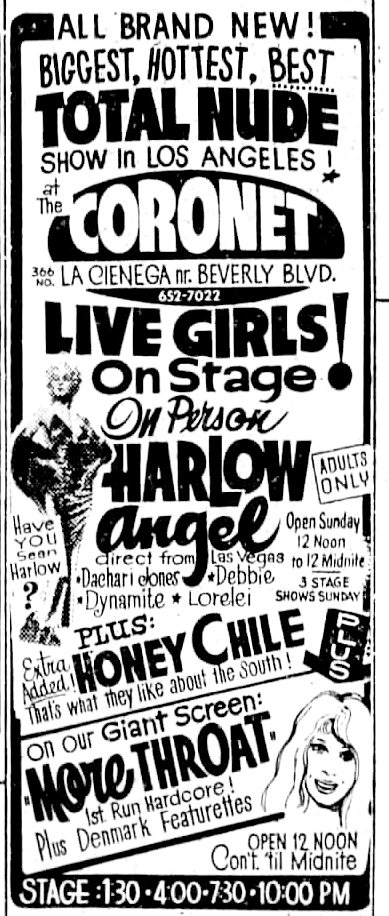
"The
New Coronet Action Theatre" represented a quest for a different
clientele with a burlesque operation. It's a 1973 ad, another find by
Ken McIntyre. It's unknown who the theatre was leased to at the time.
Another 1973 ad located by Ken McIntyre.
1975:
The Coronet became a legit operation again in 1975.
| back to top - film at the coronet | main Coronet page | 16mm revival houses | Westside theatres | Hollywood | Westwood and Brentwood | Along the Coast | Westside theatres: alphabetical list | Westside theatres: by street address | Downtown theatres | [more] Los Angeles movie palaces | Los Angeles theatres - the main alphabetical list | theatre history resources | film and theatre tech resources | contact info | welcome and site navigation guide |
.jpg)


.jpg)




No comments:
Post a Comment