1822 N. Vermont Ave. Los Angeles, CA 90027 |
map |
Opening: It opened February 14, 1935 with "What Every Woman Knows" and "Babes in Toyland." It's on the east side of the street three blocks north of Hollywood
Blvd. The theatre is now a triplex with first-run product in Cinemas 2 and 3. The American Cinematheque books Cinema 1.
Website: www.vintagecinemas.com/losfeliz | photo tour page | American Cinematheque
Phone: 213-664-2169
Architect: Clifford A. Balch
Seating:
780 originally as a single screen house. In the 1970s Variety was
reporting the count as 763. As a triplex the big house, the front of
the original theatre, has 144 seats. The smaller ones are in the rear of
the original auditorium. The capacity is 60 in Cinema 2 and 55 in Cinema 3.
An earlier Los Feliz Theatre project: In 1930 Fox West Coast planned a theatre nearby that was also to to be called the Los Feliz. That project that wasn't pursued. See an article and a Morgan, Walls and Clements drawing at the bottom of the page.
The project was announced with this item in the November 1, 1934 issue of the Hollywood Citizen-News. Thanks to Debra Matlock for locating it. She's the past-president of the
Los Feliz Improvement Association.
An opening night photo that appeared in the March 9, 1935 issue of Motion Picture Herald
with an article titled "New Theatres From Old: The Front." Note the original array of cascading lights. The tower
was later modified.
The March 1935 Motion Picture Herald article also included this diagram of the
"fountain that actually overflows with colored light." Note that they
have credited S. Charles Lee as the architect, evidently an editing
mistake. The article also featured a sketch of Lee's Studio/Holly Theatre in Hollywood. The sketch and specifications for the project were credited to General Electric Laboratories. Thanks to Bob
Foreman for finding the article. See his Vintage Theatre Catalogs site for a vast trove of tech and theatre history information that he has collected.
Variety noted the theatre's opening date in their March 20, 1935 issue. They also
mentioned that the original lessee was Herman Lewis. Thanks to Bob
Foreman for finding the item.
The opening night photo that had run with the March 1935 article in Motion Picture Herald was also spotted by Joe Vogel in the June 29, 1935 issue of Boxoffice. Their caption:
"The Los Feliz Theatre front is an excellent example
of how color and motion can be combined to present an effective
advertising appeal. The tower, representing a fountain in appearance, is
given a mobile effect by the use of amber and green lamps on alternate
circuits located behind the silhouette letters and behind the conical
sections.
"The attraction sign, made up of silhouette letters on a
smoothly luminous flashed-opal background, is modern in appearance.
Designed and installed by Luminous Structures, Incorporated, Los
Angeles, Calif. C. A. Balch, architect."
The venue was a second run family oriented single screen theatre
for
decades. Later it was an art house running for years under Laemmle management. Kurt and Max Laemmle had started their Laemmle Theatres chain in 1938 when they took over the Franklin Theatre in Highland Park. They later added the nearby Dale and the Park theatres as well as the Ritz in Inglewood. Kurt left the operation in the 1950s when business plummeted due to television and the chain dwindled until only the Los Feliz remained under Laemmle management. The circuit didn't begin growing again until the 1960s with the expansion into Westwood and other areas.
Under Laemmle management the Los Feliz became one of the premiere foreign film venues in L.A. They had a chance to buy the building but didn't. They left the theatre when their lease expired after new owner Denley Investment Company, a privately held real estate firm headed by Mehdi Bolour, wanted to raise the rent from $1,000 a month to $8,000.
Around 1987 Tommy Cooper took over the house after negotiating a slight rent concession, thinking he could still turn a profit. He gave up after a year. Tommy was renowned for running the Vagabond Theatre on Wilshire from 1975 until 1985 and the Tiffany Theatre on Sunset from 1977 until 1983. The Los Feliz chapter in Tommy's career gets discussed by J.J. Englender in his article "The Vagabond Theater" on the site Adsausage. In 1988 Tommy turned over his lease to Fred Hicks, who promised to continue the artsy programming. Fred and his company Plaza Entertainment had also been running the Vista after Landmark left that house in 1985.
Up next as a tenant was Lance Alspaugh, of what was at the time known as 5 Star Theatres. He later bought the building and triplexed the theatre in 1993 with a reopening on October 15. The company is now known as Vintage Cinemas.
A 1993 ad for the reopening as a triplex. Thanks to Scott Weinfeld for locating it for a post on Cinema Treasures.
Status:
The theatre continues to do well as a triplex offering first run
releases on the two smaller screens. Since August 2021 the larger house has been programmed by American Cinematheque with new releases and revivals. They have installed 35mm
equipment in that one. The theatre is still operated by Vintage Cinemas.
Company owner Lance Alspaugh died in October 2025. He
also operated the Village Theatres in Coronado and owned the Vista Theatre,
until its 2021 sale to Quentin Tarantino. The Los Feliz continues to
operate, with others in the management team stepping up. Lance is
survived by his mother Gwynne Lee Alspaugh and sister Shelli Sloan. Thanks to longtime employee Edwin Gomez for sharing the news. The image is from a photo by Keith Kurland appearing with his "Interview with Lance Alspaugh." Thanks to Amelia Eichler for locating the Coronado Times obituary that appeared October 19:
"The
reviews are in for Lance Clayton Alspaugh: A legend. This is what a
true cinema hero looks like. Good man, kind soul. A principled and
decisive business associate. Most importantly, Lance treasured Victor,
his life partner for 37 years, and was a beloved son, brother,
brother-in-law, uncle, and friend. Lance had a drive and zest for life
that was contagious. He had a gift for conversation. When you spoke to
him, he made you feel as if you were the only person in the room.
Lance’s generosity knew no bounds.
"Born
in Tulsa, Oklahoma, Lance’s love of movies began when he was 7, when
his dad gave him an 8 millimeter projector for his birthday. Lance made
movies with a Super 8 camera, his family and friends were the stars. His
first screening room was his family’s living room. As a hint of his
future legacy, he made sure that the presentation was perfect, and that
each person had a good view. From Tulsa to Overland Park, Kansas, Lance
worked his first job at 16 as an usher with Mann Theatres. When he was
18, Mann offered Lance a job in Los Angeles as Assistant Manager of the
Grauman’s Chinese Theatre. He took the job and moved to Los Angeles.
"In
1991, Lance took an opportunity to acquire the Los Feliz 3 Cinemas and
the Vista Theatre, and in 1997, the two theatres were in his portfolio.
Over time, he renovated and revived both theatres to the iconic status
that they are today. Lance formed Vintage Theatres, and in 2011, worked
with the City of Coronado to acquire the Village Coronado Theatre; he
counted that acquisition and renovation as one of the most joyous
experiences of his life.
"Throughout his life, he made sure that
the spotlight was on the movies. Now, the spotlight is directly on him
and the vibrant person that he was. He would be humbled by the
outpouring of goodwill and affection, and he would thank each of you for
remembering him. Lance leaves behind his Life Partner Victor Martinez,
Mother Gwynne Lee Alspaugh, Sister Shelli Sloan, Brother-in-Law George
Sloan, his Partner’s Mother Maria Martinez, extended family and friends.
Service and internment was held at the White Church of the Hills,
Forest Lawn Hollywood Hills. Submitted by the family."
Interior views:
Looking in from the front doors. The hall to Cinemas 1 and 2 is to the right of the bar. Photo: Bill Counter - 2025
The entrance to Cinema #3 to the left of the bar. Thanks to Donna G. for this 2018 photo she shared on Yelp.
Cinema #3, one of the two small houses in back. Thanks to Rhonald N. for this 2019 look down the aisle that was shared on Yelp. The capacity here is 55.
A view to the front doors after coming out of Cinema #3. Photo: Bill Counter - 2025
Along the bar. Photo: Bill Counter - 2025
Filmmaker Hayeong Moon discusses details of an upcoming screening with the manager. The film is "Bud Lives!," a documentary about jazz legend Bud Powell. Photo: Bill Counter - 2025
A display up for the October 1, 2025 screening of "Bud Lives!" See clips from the film on
YouTube and visit
norestudio, Haeyong's website.
The entrance to Cinema #2 is to the left, just beyond this doorway. Photo: Bill Counter
Cinema #2, the other small auditorium in the rear. The capacity here is 60. Photo: Bill Counter- 2025
Another look into #2. It's a 2014 photo by Mike R. appearing on Yelp.
The screen in #2. Thanks to Martin K. for sharing his 2021 photo on Yelp.
The rear of Cinema #2, using ports of the original booth. Photo: Bill Counter - 2025
The hall to the right of the two rear auditoria that leads to Cinema #1, the larger house in front. Photo: Bill Counter - 2010
Taking a right to the restrooms half way down the hall. Thanks to Allison C. for this 2017 shot on Yelp.
The big auditorium -- a shallow theatre in the front half of the original space. The capacity is 144. Photo: Bill Counter - 2010
A wider view to house right in Cinema #1. Photo: Bill Counter - 2021
A house left view in the "big house." Photo: Bill Counter - 2021
A look back to the booth. Digital in the middle, Simplex XLs on either side. Photo: Bill Counter - 2024
Looking back up the hall to the lobby. Photo: Bill Counter - 2025
The Cinema #2 entrance, just before reaching the lobby. Photo: Bill Counter - 2025
A view to the street. Photo: Bill Counter - 2025
More exterior views:
Thanks to Sean Ault for finding this view of the marquee taken during the run of "The Eleanor Roosevelt Story," a 1965 release.
A 1967 "Shakespeare Wallah" shot Grant Taylor found in a box of old photos and shared on the private Facebook groups
SoCal Historic Architecture and
Photos of Los Angeles. "Pather Panchali" had its original US release in 1958. Thanks, Grant. And thanks to Bruce Kimmel for determining that this program opened February 15.
A great 70s telephoto view looking north on Vermont from Hollywood Blvd. It was added by Don Sherman to the page for the
Photos of Los Angeles Facebook group. The Los Feliz marquee is right under the "don't walk" sign. The corner on the left is the former location of the
Studio Theatre.
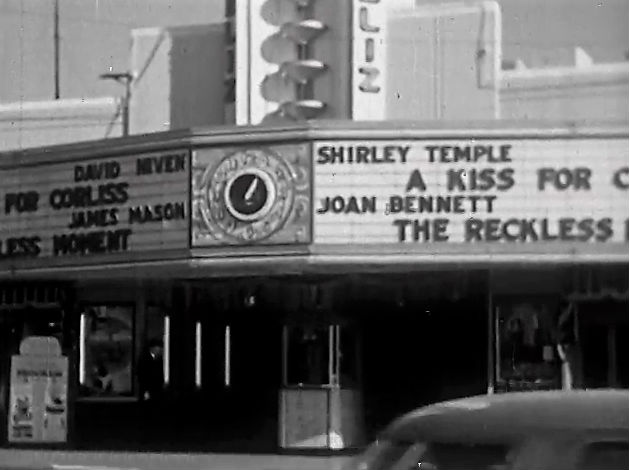
Thanks to the now-vanished American Classic Images website for this 1980 photo.
A January 1983 look at the neon from the American Classic Images collection.
Thanks to Wayne Lawless for this 80s view of the theatre in its single-screen days. He added it as a comment to a post about the theatre on the
LAHTF Facebook page.
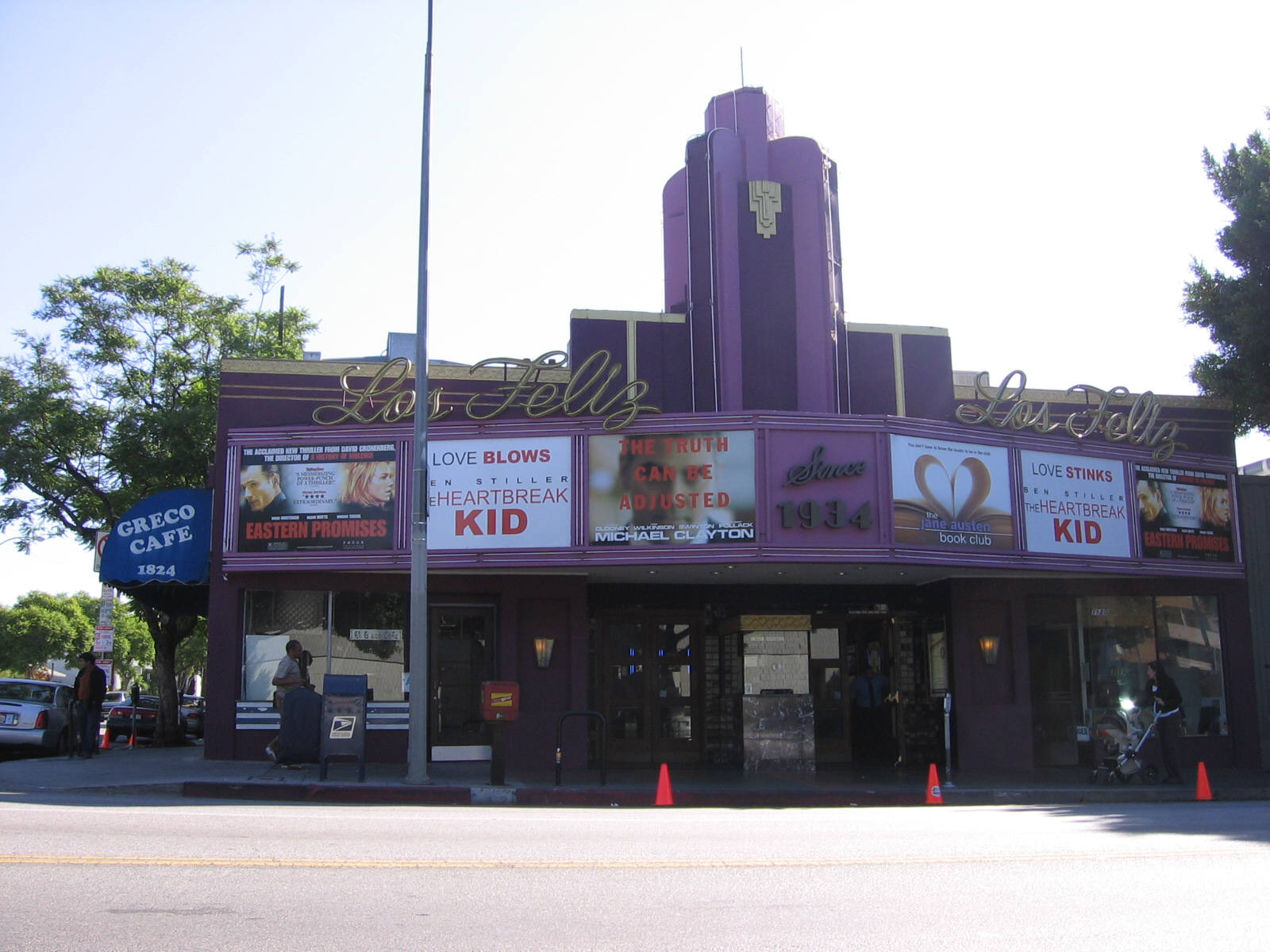
The theatre in 2007. Photo: Bill Counter
A night view of the Los Feliz Theatre neon. Thanks to Mark Peacock for his 2009 photo. It's from his
Vintage Theatres set on Flickr. Also visit his blog:
On the Road With Mark Peacock.
Looking south on Vermont. Photo: Bill Counter - 2010
The entrance to the theatre. Photo: Bill Counter - 2010
A closer view of the Boxoffice. Photo: Bill Counter - 2010
Thanks to Ken McIntyre for finding this 2012 shot for a post for the private Facebook group
Photos of Los Angeles.
"
10 Surefire Signs You're Not From L.A.," a fine November 2013 L.A. Weekly article by Dennis Romero, included this 2011 look at the front of the Los Feliz from
Michael Locke on Flickr. It's on
page three of the article.
Thanks to Shawn Dudley for his July 2017 photo, added as a comment on the
Los Angeles Theatres Facebook page. Despite what the marquee says, the theatre didn't open until 1935.
"Is it safe?" "Fasten your seatbelts, it's going to be a bumpy night." "Just keep swimming..." Unlike some theatres (think Cinerama Dome) that just left signage up from whatever they happened to be playing when the virus lockdown was ordered, Vintage Cinemas had panels made with more interesting copy. Thanks to Eitan Alexander for noting the copy on the marquee. Photo: Bill Counter - April 2020
The north readerboard. Photo: Bill Counter - April 2020
The south readerboard. Photo: Bill Counter - April 2020
Well, yellow and purple is certainly an eye-catching color combination. The Cinematheque was moving in to start programming the large house. Photo: Bill Counter - June 1, 2021
Thanks to Sean Ault for this August 2022 photo.
Thanks to Stephen Russo for sharing this September 2024 photo he took.
The Los Feliz in the Movies:
The exterior of the theatre is seen in the ten minute public service
film "The Dangerous Stranger" (Sidney Davis Productions, 1950). Thanks
to Cinema Treasures contributor Bobster1985 for the screenshot. See
several more from him on the
Cinema Treasures page. Or see the
Historic L.A. Theatres in Movies post. Note the partial view of the original tower configuration.
We get a very quick drive-by about 27 minutes into "Hot Rod Gang" (American International, 1958). The
film, directed by Lew
Landers, is about a kid who joins a rock band to earn money to support
his drag racing habit. It stars John Ashley, Jody Fair and Gene Vincent. The cinematography was by Floyd Crosby.
We don't see much more as "Hot Rod Gang" cuts to a dissolve
into a party scene but the marquee and the vertical sign are seen over
on on the right. See the
Historic L.A. Theatres in Movies post for two views of the Monica Theatre and two of the Vista.
We
get this fine look at the Los Feliz in
"The Slams" (MGM, 1973). Jim Brown, Judy Pace and Roland Bob Harris
star in this crime drama about a quest for money stashed before Brown
was sent to prison. Jonathan Kaplan directed. The film also spends some
time at the Lincoln
Heights jail, in the LaCienega oil fields and at Pacific Ocean Park.
Thanks to Eric Schaefer for spotting the theatre in the film and
getting the screenshot.
Sally
Field and Michael Caine leave a
screening of "Otello" at the Los Feliz Theatre, 1822 N. Vermont Ave., in
"Surrender" (Warner Bros., 1987). It's a comedy directed by Jerry
Belson about a writer who's pretending to be poor so he'll know any
women he meets aren't just after his money. Juan Ruiz Anchía did the
cinematography. Thanks to Eric Schaefer for spotting the theatre in the
film and
getting the screenshot.

A "Gala Premier" is happening in this shot from "Red Nights" (Trans World Entertainment, 1988). Or is it a "Premiere"? Thanks to Rio
Dylan Hernandez for spotting the many theatres in the film and getting
screenshots. It's another young-man-goes-to-Hollywood story. He thinks he's going to
become an actor but sinks into the violent shadows. Izhak Hanooka
directed. The cast includes Christopher Louis Parker, Brian Matthews,
Tom Badall and Patty Bauer. The cinematography was by Jacob Eleasari. The
Historic L.A. Theatres in Movies post has shots of the X Theatre, the Vogue, the Chinese and the Hollywood Blvd. Pussycat.
A Mormon missionary gets talked into
becoming a porno star in Trey Parker's "Orgazmo"
(October Films, 1998). When his film, also called "Orgazmo," becomes a
big hit and starts playing mainstream theatres we get this shot. Trey
Parker stars. Also featured are Dian Bachar, Robyn Lynne Raab, Michael
Dean Jacobs and Ron Jeremy. Trey Parker and Matt Stone wrote this epic. The cinematography was by Kenny Gioseffi. Thanks to to Cinema Treasures contributor
Shoeshoe14 for spotting the Los Feliz. See the
Historic L.A. Theatres in Movies post for an earlier marquee shot of an unidentified theatre.
Dimitri Martin and Gillian Jacobs, a prospective girlfriend, wander in
front of the Los Feliz Theatre, 1822 N. Vermont Ave., in "Dean" (CBS
Films, 2017). Martin also wrote, directed and illustrated the film, a tale about a
misfit cartoonist and his curious adventures with various friends and
lovers. The film also stars Kevin Kline as the dad and Mary Steenburgen
as a real estate agent he falls for.
The Los Feliz on TV:
Kristen
Bell and Adam Brody are in front of the theatre in episode two of
"Nobody Wants This" (Netflix, 2023). This shot and the one below are
from a clip used in a
two-minute "We Love LA" montage made for the 2025 SAG awards, held at
the
Shrine Expo Hall. The SAG segment is on Facebook as a post from
Vintage Los Angeles. Alison Martino was involved in selecting the clips used.
Going in for the kiss.
More Information: The
Cinema Treasures page on the Los Feliz has lots of historical data on the theatre as well as links to more exterior photos.
Cinema Tour has a nice set of 2008 views (including interior shots) by Mark Campbell. The
Yelp page about the theatre has over a hundred photos.
There's lots of data about the Los Feliz in the 1980s when it was under Tommy Cooper's management in the Adsausage Archives article "
The Vagabond Theatre." Thanks to J.J. Englender for sharing it. The Vagabond and Tiffany were other operations Tommy was involved in.
The earlier Los Feliz Theatre project: In 1930 Fox West Coast announced plans to build a theatre on the west side of Vermont at Franklin Ave. to be called the Fox Los Feliz.
Thanks to Debra Matlock for researching the project. She's the president of the Los Feliz Improvement Association. Debra located this article in the April 18, 1930 issue of the Los Angeles Evening Express:
The article begins with notes about two that DID get open, the
Pantages and the
Fox Wilshire. The "NEW HOUSE" section that follows discusses two that didn't get built: the Los Feliz and the Garden Theatre at La Brea and Melrose. The
Stadium Theatre also gets a mention in this section, a house that opened on Pico in March 1931.
The "WESTWOOD THEATER" section mentions the
Village Theatre, opened in August 1931 along with four more that were never built: the Sunkist in Compton, the Venice on Windward Ave., the California in San Pedro and a new Fox for Huntington Park.
"... old worldish in its atmosphere with a French influence." This drawing from architects Morgan, Walls & Clements appeared in the July 12, 1930 issue of the Express. Thanks, Debra!
Nearby: Los Feliz Drive-In | Studio Theatre | Vista Theatre |
| back to top | Westside theatres | Hollywood | Westwood and Brentwood | Along the Coast | Westside theatres: alphabetical list | Westside theatres: by street address | Downtown theatres | [more] Los Angeles movie palaces | Los Angeles theatres - the main alphabetical list | theatre history resources | film and theatre tech resources | contact info | welcome and site navigation guide |






Thanks for all the info + collection of photos over the years. I've lived in the area since 2012. Its a great little theater. The businesses on opposite sides of the theater are always changing but usually its a cafe or burger joint or similar. Covid almost closed the nearby vista for good (thanks quentin for buying it), and this place probably would have shuttered too if AC didnt enter into a partnership to host films in the main complex of the theater. I spent many nights on vermont ave, having a glass of HH wine at figaro, catching a movie at the los feliz 3, then a bite to eat at fred 62. That block is 1 of the most fun in LA. I looked at the photo of the street in the 1970s, nothing remains except the theater and the old sarnos pastry sign. I'm sure in another 20 or 30 years i'll look back and recognize nothing of the neighborhood i've called home for 1/3 of my life so far.
ReplyDeleteThanks for your comments!
DeleteLos Feliz Theater was used in episode of King of Queens. Doug saves Carrie from getting hit by a slow-moving bus.
ReplyDeleteThanks!
Delete